Living Shorelines in Beausoleil: protecting our coast, naturally
Along our coast, erosion claims a little more ground every year. In Beausoleil, one project offers a response that works with nature instead of against it: Living Shorelines. For several seasons now, many residents and volunteers have rolled up their sleeves to give our shores the means to defend themselves.
The project at a glance
Living Shorelines is a coastal restoration approach led by the Pays de Cocagne Sustainable Development Group (GDDPC), in partnership with the Rural Community of Beausoleil.
The technical expertise comes from Rosmarie Lohnes and her team at Helping Nature Heal, a Nova Scotia company specializing in ecosystem restoration. The idea is simple: protect coastal and riverfront land by imitating nature, almost entirely by hand, with as little mechanical intervention as possible.
The workshops and projects take place in several coastal zones in our region.
How it protects our shores
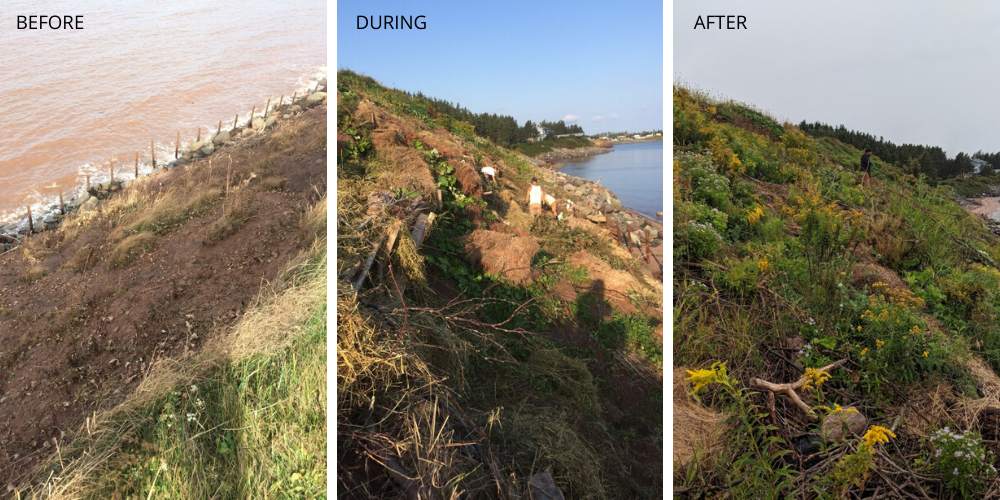
Rather than pouring concrete or piling up rock (riprap), the Living Shorelines approach relies on living, natural materials. In practice, the work combines a few complementary techniques:
- Wattle fences: woven branches of willow and alder, anchored to the ground, form a flexible barrier that softens waves and slows rainwater runoff.
- Native plants: marram grass planted at the base of the slope holds the sand in place with its roots, while willow, alder, rose, iris and cattail stabilize the higher banks.
- Branches and straw: spread around the plantings, they protect the young plants while they take root.
Over time, the roots weave a living net that keeps the soil in place. The shoreline grows more resistant to waves, storm surges and heavy rain, while staying flexible and able to adapt.
Why it matters for Beausoleil
Our community is shaped by water, and storms are becoming more intense because of climate change. Whether or not you live by the water, our shorelines are part of what brings us together. Living Shorelines offer a sustainable and affordable way for us to protect them together.
This approach brings several benefits to residents:
- It slows the erosion that threatens properties, trails and water access.
- It absorbs storm surges and runoff more effectively, reducing damage during high tides.
- It recreates natural habitat for birds, pollinators and coastal life. The Cocagne Community Park is recognized as an important site for migrating birds.
- It passes practical know-how to waterfront landowners, who can apply these methods at home as an alternative to riprap.
A community at work
Above all, this project runs on participation.
From August 26 to 28 2025, at Notre Centre in Grande-Digue, more than 25 participants put in over 165 hours of collective work. Together they planted close to 200 plants and installed about 100 metres of wattle fencing.
On June 3 and 4 2026, at the Cocagne Marina, about twenty representatives from environmental groups devoted more than 120 hours to maintaining the installations built since 2023. The wattle fence was reinforced, and roughly 280 plants went into the ground, including 144 marram grass plants and about a hundred willow cuttings.
And that is only a snapshot: since 2021, hundreds of people have helped restore our shores, one workshop at a time.
In their own words
“It’s amazing what teamwork can accomplish when faced with a large-scale task or project like the one carried out at the community park—and in such a short time.”
— Participant (2021)
“By proposing a solution that uses and mimics nature, we are promoting the conservation of a natural environment, as well as the preservation of the local ecosystem and its biodiversity”
— Jérôme Légère, program coordinator at GDDPC
"It’s wonderful to see the transition from a fully mowed lawn, crumbling rock wall to something that is much more sustainable, vibrant and abundant.”
— Rosmarie Lohnes, President of Helping Nature Heal
How to get involved
Living Shorelines is a project built together, season after season. Whether you are a waterfront owner curious about a natural solution, or simply someone who loves getting their hands in the soil, there is a place for you at the next workshops.
To learn more about the project, the annual reports or upcoming worksite dates, contact the Pays de Cocagne Sustainable Development Group at 506-576-8247 or visit ecopaysdecocagne.ca.
This initiative is made possible through the New Brunswick Environmental Trust Fund, the New Brunswick Wildlife Trust Fund, Nature NB, the New Brunswick Environmental Network and the Rural Community of Beausoleil.
